COURSE AFTER 12th COMMERCE
jain news jain mantra jain music stavan songs news facts astrology vastu shastra health treatment baby names india tourist place news ayurvedic upchar health disease best places to visit in india and world health blogging hosting domain wishing message blogging blogger tips free adsense friendly template theme for blogger blogspot.com blogger blogspot.com adsense blogging tips in english hindi blogging tips e cards wishing images
Showing posts with label education. Show all posts
COURSE AFTER 12th SCIENCE (PCMB) (Biology & Maths)
COURSE AFTER 12th SCIENCE (PCMB)(Biology & Maths)
Courses after 12th science PCMB
COURSE AFTER 12th SCIENCE(PCMB)(Biology & Maths)
After 12th science (PCMB)
Those with +2 science Bio-maths can take up either an engineering or a medical career. Admission to these professional courses are through entrance examinations and if you select engineering than see after PCM and if you select Medical than see after PCB
If not interested in engineering and medical field, 10+2 science students can go for B.Sc. (Bachelor of Science) program of their choice of interest, which can be followed by Master's degree (M.Sc.), Ph.D and M.Phil. Teaching is another option.
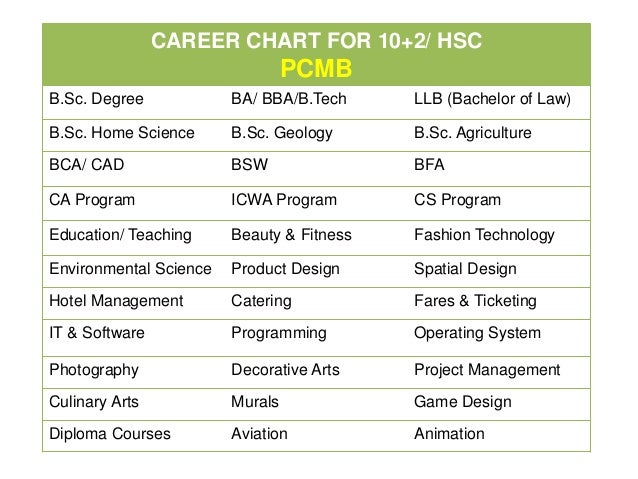
B.sc.(Bachelor of science):-
B.sc.in biotechnology:-
B.Sc. in Biotechnology is a 3- year undergraduate course, involving an advanced study of the cellular and bimolecular processes for development of a variety of technologies and products that contribute to improving people’s lives and health.
ad
s
The course is divided across 6 semesters, of six months each, and the basic eligibility for applying to the course is 10+2 qualification in the science stream, completed from a recognized educational board. The course is offered in India at an average fee ranging between INR 1 and 3 lacs, varying across institutes.
B.sc. in agriculture:-
B.Sc. Agriculture is a 4-year undergraduate degree awarded by Indian Universities for 10+2 students preferably with Science stream. Like, BE/B.Tech or MBBS, B.Sc. in Agriculture is considered as a professional degree by Government of India. The course is not so popular among students but the demand for trained professionals in agriculture is very high.
Admission to the course is mostly entrance exam based. KEAM, EAMCET are a few entrance exams conducted for admission to the course. There are 42 State Agricultural Universities (SAUs), 1 Central Agricultural University (CAU), 5 Deemed Universities (DUs) and 4 general Central Universities with Agriculture faculty in India. These institutions provide admission at UG level in 11 disciplines and about 15,000 students get enrolled every year.
B.sc.in Dairy technology:-
It is an Agriculture and Technology graduate course. This course covers the topics related to animal health and livestock, dairy technology, dairy farming and milking, dairy products and services, dairy plant maintenance, etc. This course has been designed for meeting the demand of growing needs of experts in Master of Science with Dairy Science. The main objective of this course is to yield more milk from animals through the use of technology and to prevent spoilage, improve quality of milk and make milk edible and safe for human consumption.
Courses after 10 ITI
COURSE AFTER 10th(ITI)
Course After 10th(ITI):-
Class 10 board exam results have been announced by CBSE, ICSE and most of the state education boards and it is time for students to decide what to do next. If you think that industrial work and small-scale businesses is your thing then ITI courses after 10th can help you in getting good jobs after completing the course. ITI courses after 10th are for students who want to pursue short-term courses in order to pursue jobs.
If you want to start earning early, then courses offered by ITI after class 10 is one of the best options that you have. ITI courses after 10th can also help you choose specializations according to your area of interest as Industrial Training Institutes (ITI) offer diverse programmes in engineering as well as non-engineering fields. Check out the different courses offered by ITI after class 10th below.
ITI Course:-(stream, Duration,course):-
Tool & Die Maker Engineering:-
Engineering
3 years
Draughtsman (Mechanical) Engineering:-
Engineering
2 years
Diesel Mechanic Engineering:-
Engineering
1 year
Draughtsman (Civil) Engineering:-
Engineering
2 years
Pump Operator:-
Engineering
1 year
Fitter Engineering:-
Engineering
2 years
Motor Driving-cum-Mechanic Engineering:-
Engineering
1 year
Turner Engineering:-
Engineering
2 years
Dress Making:-
Non-engineering
1 year
Manufacture Foot Wear:-
Non-engineering
1 year
Information Technology & E.S.M. Engineering:-
Engineering
2 years
Secretarial Practice:-
Non-engineering
1 year
Machinist Engineering:-
Engineering
1 year
Hair & Skin Care:-
Non-engineering
1 year
Refrigeration Engineering:-
Engineering
2 years
Fruit & Vegetable Processing:-
Non-engineering
1 year
Mech. Instrument Engineering:-
Engineering
2 years
Bleaching & Dyeing Calico Print:-
Non-engineering
1 year
Electrician Engineering:-
Engineering
2 years
Letter Press Machine Mender:-
Non-engineering
1 year
Commercial Art:-
Non-engineering
1 year
Leather Goods Maker:-
Non-engineering
1 year
Mechanic Motor Vehicle Engineering:-
Engineering
2 years
Hand Compositor:-
Non-engineering
1 year
Mechanic Radio & T.V. Engineering:-
Engineering
2 years
Mechanic Electronics Engineering:-
Engineering
2 years
Surveyor Engineering:-
Engineering
2 years
Foundry Man Engineering:-
Engineering
1 year
Sheet Metal Worker Engineering:-
Engineering
1 year
Course after 10th IN SCIENCE
AFTER 10th IN SCIENCE
AFTER 10th(in Science)
career after 10th:-
The moment a student completes his/her 10th Boards and decides to take up Science as his/her stream, he/she has to make the tough choice of choosing either Physics, Chemistry, Mathematics (PCM) or Physics, Chemistry, Biology (PCB) as career after 10th for the next two years. The student is even more confused with the plethora of suggestions that are bombarded on him/her from all quarters, be it parents, relatives or peers. Some who want to have a number of options available to them after 12th or are just plain adventurous, decide to opt for both Mathematics and Biology(PCMB). We are here to debunk the old myths and help you decide what suits you best in a very objective take on “career after 10th”. Of course, our focus will remain on the age-old debate of Engineering v/s Medical as these, till date, remains the most popular and lucrative career options for students of PCM and PCB respectively.
Students who want a career in engineering or quantitative sciences for themselves generally take up PCM whereas students interested in medical or biological sciences take up PCB. Only those students who are comfortable with mathematics should opt for PCM. Now in the current scenario, engineering can be completed in four years and then you can expect to get a job if you are from a decent enough college.
Doctors need to not only complete five years of basic medical study but mandatorily pursue MD or MS (almost an unsaid rule) to compete in today’s world. Some doctors choose to go for super-specialization as well. It is almost 10-11 years of toil before you get to settle in a comfortable position. That being said, doctors tend to stay doctors for most of their lives whereas 40-50% of engineers switch to other career options. India produces 15 lakh engineers compared to only 50,000 doctors every year. Given the constant shortage of doctors, especially in rural areas, they are likely to be in demand always whereas there are thousands of engineers graduating every year who are completely unemployable because of various reasons. Of course, the quality of engineers varies a lot if we compare students graduating from IITs and NITs with those from local colleges.
The cost of higher education:- for both PCM and PCB depends on a lot on the location from which you decide to pursue it. In general, government colleges are far more affordable than private colleges for both Engineering and Medical, as they receive grants from the government and the education is subsidized, although the admissions procedure is far more competitive too. Government institutes like the IITs and NITs offer quite affordable engineering education. Moreover, Masters and Doctorate students get stipends too. If you pursue your MS in engineering from a Scandinavian country or Germany, you have to pay zero tuition fees. On the other hand, you would have to pay anything from tens of lakhs to even some crore rupees as fees for an MS or MBA from the UK or the USA.
Medical education is also very expensive but in India, it is one of the cheapest in the world, especially if it is government-subsidized. While medical education from some private institutes can cost up to a crore rupees or $150,000 nowadays, government institutes offer the same for a lakh rupees or $1500-$2000, making it quite affordable for the middle-class. The same education in the US would have cost $200,000 to $300,000.
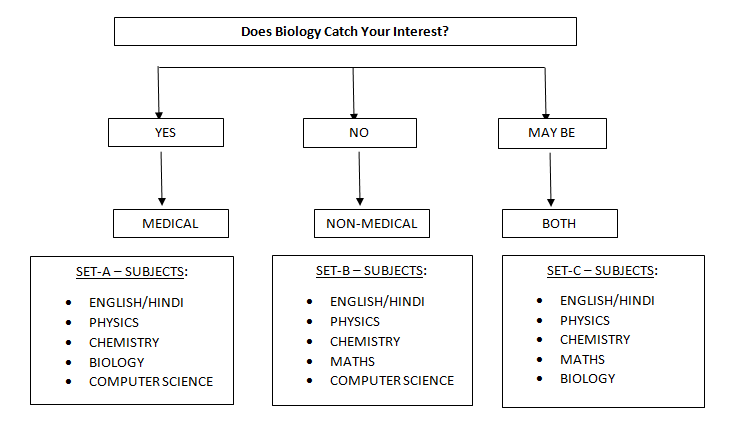
PCM(MATHS)(GROUP A):-
Subject:- physics
Maths
Chemistry
English
Computer
PCB(BIOLOGY)(GROUP B):-
Subject:- physics
Biology
Chemistry
English
Sanskrit
PCMB(GROUP A,B):-
Subject:- physics
Maths
Biology
Chemistry
English
Computer
Sanskrit
courses after 10th IN COMMERCE
AFTER 10th IN COMMERCE
AFTER 10th(IN COMMERCE):-
Commerce as a stream of education can be defined as a study of trade and business activities such as the exchange of goods and services from producer to final consumer. The main subjects that are taught in the Commerce stream in Class 11 and 12 include Economics, Accountancy and Business Studies. Choose this field if you have a genuine interest in these subjects and have an affinity for numbers, the economy and business.
The important subjects taught in the school curriculum of 11th and 12th are Economics, Accountancy, and Business Studies. Students are advised to choose this field if they have an affinity for numbers and have more interest in business and economy.
Subjects in Commerce after 10th:-
English – Will mostly include fiction and non fiction lessons and you will be expected to answer questions from the stories you read in your textbooks. Additionally, there would be some letter writing, essays, article writing, note making etc – the basic you need to know to work in an office later on.
Mathematics – Will include topics ranging from algebra, trigonometry, geometry and all topics you later in life. Why do I say later in life? Because you will definitely feel as if these topics are useless for commerce, but trust me – you’ll need those concepts in CAT or GMAT (provided you are serious about pursuing a career in commerce/business)
Accounting – Accountancy is a branch of mathematical science that is concerned with the financial information about a business entity to users such as shareholders and managers. The financial communication that is studied under the subject is generally in the form of financial statements that show in the terms of money the economic resources under the control of the management. Studying accountancy enables a student to learn and discover the various causes of successes and failures of different business enterprises
Business Studies – A subject essentially to be applied in your whole life. it will introduce you to the concepts of marketing, finance, organizational behavior and business world. From now on to MBA – to consulting or investment banking – you’ll essentially be going deeper and deeper into these concepts introduced now. The main areas of study in the subject include business organizations, their various features, structure and functioning, marketing, operations management, human resource management, etc
Economics – This subject which will teach you why the world works in a certain way in very simple terms. You’ll learn what is demand, supply, their interplay, the business systems, consumer behavior, production concepts, cost concepts and everything in between. You’ll also familiarize yourself with concepts of growth, development, poverty, inequality and governance. Economics has two broad branches – micro-economics, where the unit of analysis is the individual agent, such as a household or firm, and macro-economics, where the unit of analysis is an economy as a whole.
Statistics - Statistics is a branch of mathematics dealing with the collection, organization, analysis, interpretation and presentation of data. In applying statistics to, for example, a scientific, industrial, or social problem, it is conventional to begin with a statistical population or a statistical model process to be studied. Populations can be diverse topics such as "all people living in a country" or "every atom composing a crystal". Statistics deals with all aspects of data including the planning of data collection in terms of the design of surveys and experiments.
Subscribe to:
Posts (Atom)
Featured Post
Happy Diwali 2025: Best 100 Diwali Wishes, Quotes, Messages, WhatsApp Status, Imagesdiwali 2025 diwali date
Happy Diwali 2025: Best 100 Diwali Wishes, Quotes, Messages, WhatsApp Status, Images
advertisement
Advertisement
-
जैन दीक्षा / दिक्षार्थी / संयम पर शायरी Shayri For Jain Diksha / Diksharthi / Sanyam in Hindi
-
Siddhagiri Na Shikharo Bole Lyrics Jain Stavan
-
जैन तपस्या जैन तप पर शायरी Shayri for Jain Tapasya Jain Tap